
Read Coaching Institute Reviews in India Before You Enrol
A practical guide to checking authenticity, reading rating context and using coaching reviews without treating a star score as a promise. As of August 2026.
4 chapters · Updated Aug 29, 2026
- IS 19000:2022
- India’s online-review process standard
In brief
Use coaching institute reviews as a screening tool, not a verdict. Check for a genuine first-hand experience, possible incentives or conflicts, review date and detail, then confirm the course facts directly before paying. India’s IS 19000:2022 framework supports transparent, accurate review collection and publication.
A review is evidence, not a verdict
A coaching review can reveal details that an institute’s course page cannot, including whether students found a batch responsive, a teacher clear, or the timetable workable. It cannot guarantee that the same teacher, batch size, fee, course structure or support will apply when you enrol.
India’s review framework, IS 19000:2022, covers principles for collecting, moderating and publishing online consumer reviews. A 2024 Press Information Bureau update names integrity, accuracy, privacy, security, transparency, accessibility and responsiveness among those principles. The same update reported that National Consumer Helpline e-commerce complaints rose from 95,270 in 2018 to 4,44,034 in 2023. That figure is not about coaching alone, but it shows why review claims deserve careful handling.
Read the score as an opening question: what experiences created it, when did they occur, and do they concern the course you may join? A detailed recent review is often more useful than a bare rating, especially when it explains what worked and what did not.
Takeaway: A coaching review is strongest when it helps you ask a specific question before enrolment.
Check the source before you trust the sentiment
Start with provenance. Prefer feedback that links to an original public post or contains enough first-hand detail to show what the reviewer actually experienced. Look for the course or exam, the delivery format, the timing and the aspect being discussed. A review that only says “best coaching” or “waste of money” gives little basis for comparison.
Google’s Maps content policy says reviews should reflect genuine, unbiased experiences. It prohibits paid or in-kind reviews, multiple-account posting, incentives tied to a review, selective solicitation of positive reviews and other rating manipulation. Those rules provide useful red flags even when you are reading feedback elsewhere: repetitive wording, an unusual burst of ratings or pressure to post praise should lower confidence.
Do not assume a critical review is false because it is negative. India’s review guidance says organisations should not prevent or discourage negative reviews. Instead, test whether the criticism is specific, relevant to your intended course and consistent with other independently posted experiences.
Use this sequence before giving a star score much weight.
Review-check sequence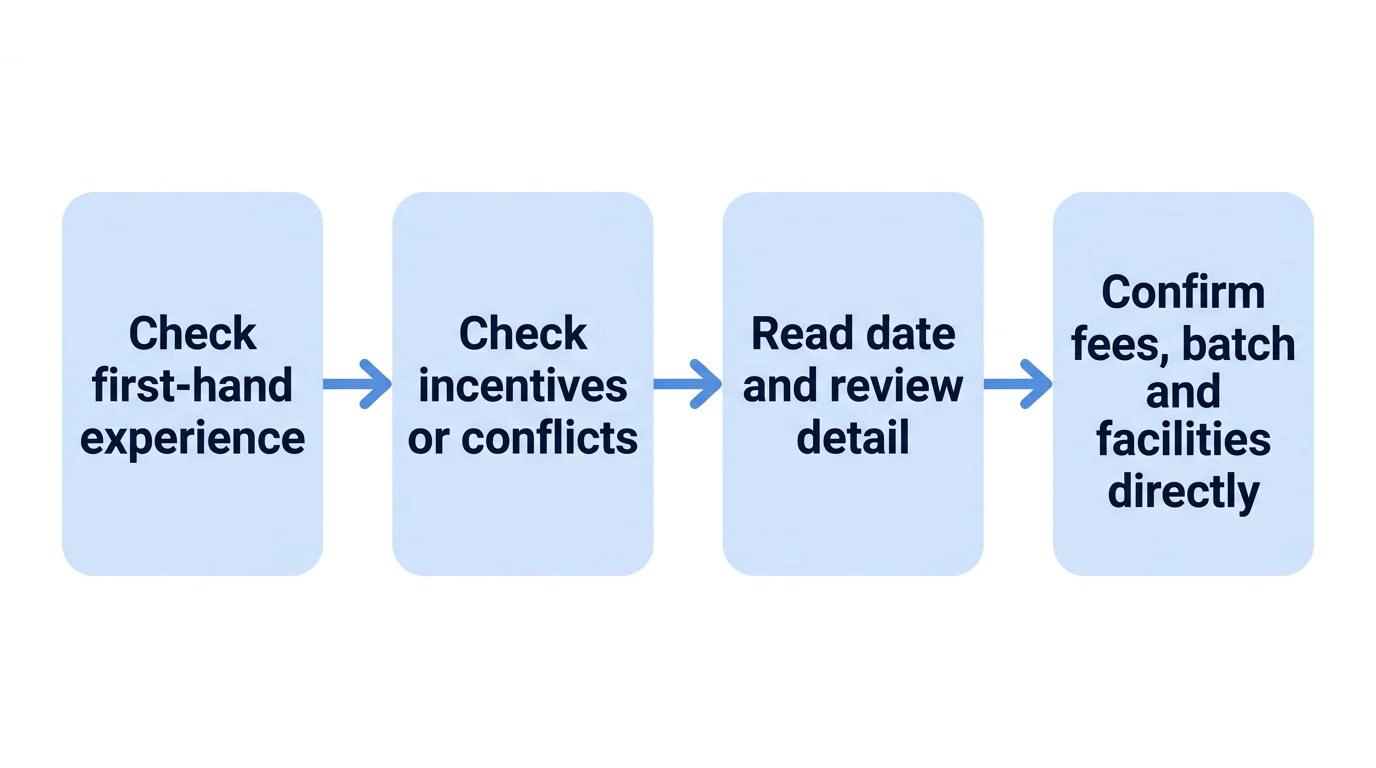
Takeaway: A review deserves more weight when its source, experience and context can be inspected.
Read the count, date and text alongside the stars
A star average is a summary, not an explanation. Compare the number of reviews, the date range, the themes in the written feedback and whether reviewers describe the same course mode you are considering. A small group of highly positive reviews may accurately describe those reviewers’ experiences while still offering limited evidence about how broadly the pattern holds.
Review design also shapes what a score means. A Management Science study reported results from seven experiments showing that the design of a rating system can systematically influence overall ratings. Separate research in Marketing Science found that individual review content can affect purchase likelihood even after accounting for the average rating, particularly when it resolves uncertainty.
For coaching, search the text for concrete themes: faculty continuity, doubt support, mock tests, pace, class size, recorded access and administration. Then distinguish a mismatch in student preference from a claim about a promised service not being delivered. This slower reading is less useful when you only want a quick shortlist, but it is more useful before a substantial payment or a long course commitment.
Takeaway: The meaning of a rating comes from its context, not from the decimal alone.
Turn review themes into questions you can verify
After reading reviews, make a short list of claims worth checking directly. If reviewers praise a teacher, ask who teaches your prospective batch. If they mention fast doubt resolution, ask how doubts are submitted and when responses are available. If fee complaints recur, request the current written fee and refund or cancellation terms before payment.
Online Coaching 4u states that its Verified badge means an institute has confirmed its listing details. Treat that as a detail-confirmation signal, then assess review evidence separately. Its review pages link public Google and Reddit material back to the original posts where available, which lets readers inspect the surrounding context rather than rely on an extracted quote.
This approach is not designed to produce a universal “best institute” list. Students preparing for different exams, studying online or in person, and needing different schedules can reasonably value different features. Reviews help identify patterns and questions. Direct confirmation determines whether the current offering matches the pattern you need.
Takeaway: Use reviews to prepare better questions, then verify the current course before you pay.
Go deeper
Frequently asked
Look for a review that describes a specific first-hand experience, such as the course, batch, teaching, doubts, materials or support received. Check whether the reviewer profile and timing add context, and be cautious about copied wording, sudden clusters of similar reviews, incentives or undisclosed connections to the institute.
A high rating based on a small set of reviews can be useful as a starting signal, but it does not establish how consistently an institute delivers for a wider group of students. Read the review text, check the dates, and compare recurring comments with the course, faculty and batch information that matters to you.
A platform’s moderation policy determines whether a review stays visible. India’s online-review framework says organisations should not prevent or discourage negative reviews, while platforms may still remove content that breaches rules such as abuse, spam or impersonation. A negative review should be assessed for detail and relevance, not dismissed solely for being critical.
Confirm the current fee, batch schedule, course format, faculty, study materials, facilities and refund or cancellation terms directly with the institute before payment. Reviews can surface questions to ask, but they cannot confirm that a past reviewer’s batch, teacher, fee or experience will match the programme currently being offered.
Review coaching options with the original context in view
Open the review hub to inspect linked public feedback alongside institute profiles.
Browse coaching reviews