Can You Trust a Coaching Institute Review? Take the Evidence Check
Answer seven quick questions about the review set you are considering. Each answer adds risk points, so lower totals mean the evidence is easier to inspect.
Question 1 of 7
How current and relevant are the reviews?
Pick an answer to continue. Your result appears after question 7.
Updated 25 Sept 2026
In brief
A coaching review is useful only when its source, context and claims can be inspected. This seven-question evidence check scores the review set, not the institute, so you can decide whether to shortlist it, verify more, or set it aside.
What the score tests
Each answer adds 0, 1 or 2 risk points. Lower points mean the review set gives you more inspectable evidence. A total from 0 to 4 suggests stronger evidence, 5 to 9 suggests incomplete evidence, and 10 or more means the review set should not stand alone.
India's IS 19000:2022 review framework covers collection, moderation and publication, with principles including integrity, accuracy and transparency, according to the Department of Consumer Affairs. The CCPA's 2024 coaching-advertising guidelines also make corroboration important when a review repeats claims about results, fees, refunds or course delivery, because misleading claims and concealed material information are prohibited under the official guidelines.
This assessment cannot authenticate a reviewer, test teaching quality or replace a current written course quote. Use it to decide how much weight public feedback deserves, not to make a final enrolment decision from stars alone.
Read the evidence in three groups
The first group asks whether the reviews have an identifiable source. The second checks whether the feedback matches the course, branch and period you may join. The final group checks whether important promises can be confirmed outside the review set.
Seven checks before a review earns weight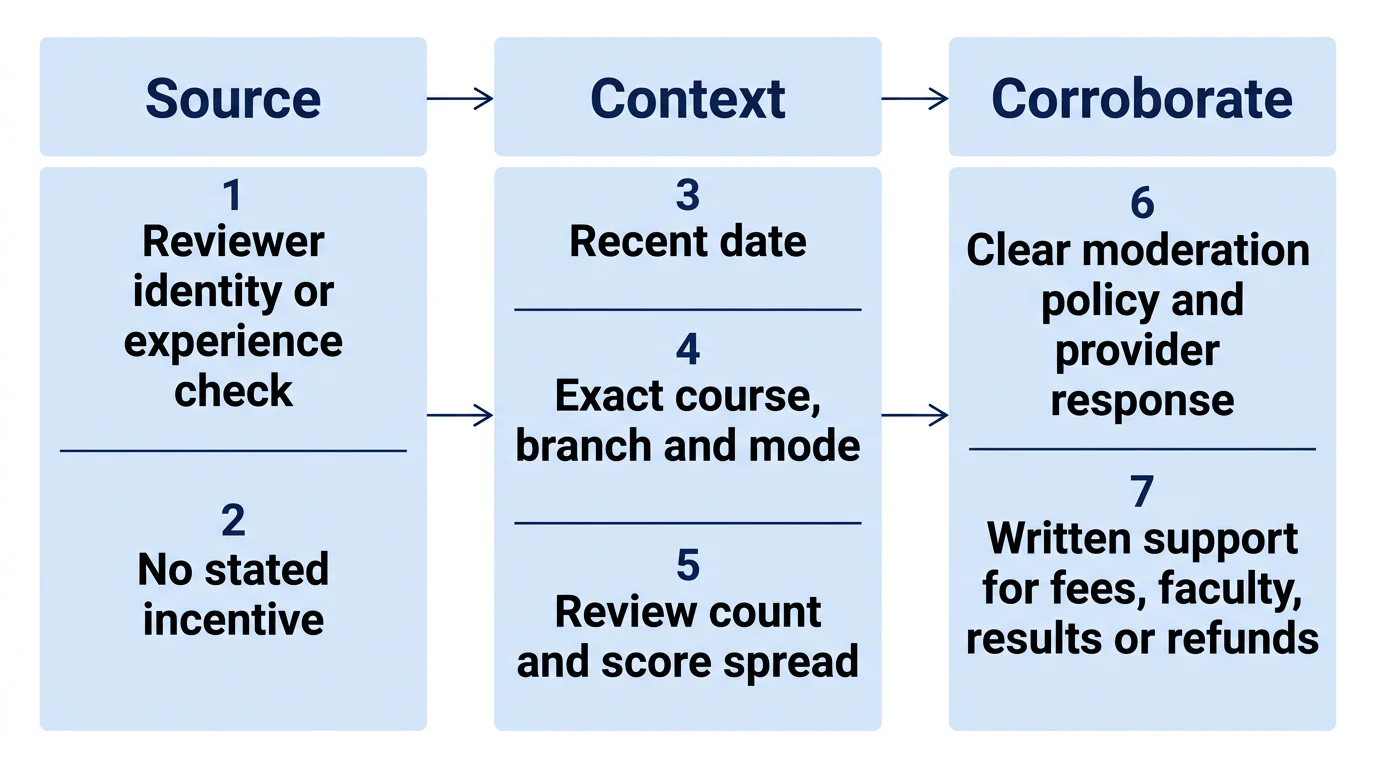
What this assessment asks
7 questions. Each answer carries points; your total picks the result band below.
01How current and relevant are the reviews?
- They have no useful dates or describe a clearly older course
- They are recent and discuss the course currently offered
- They have dates, but relevance to the current course is unclear
02How specific is the written feedback?
- It identifies part of the experience but leaves important context out
- It is mainly generic praise or criticism
- It names the course, branch or mode and describes a first-hand experience
03Can you see the review count and the pattern behind the stars?
- The count is visible and written reviews show more than one viewpoint
- The count, distribution or review text is hidden or unclear
- The count is visible, but the rating pattern or review text gives limited context
04Does the platform explain how reviews are collected or checked?
- It mentions checks, but the method is not clear
- It gives no useful explanation, or incentives are a concern
- It explains reviewer or experience checks and shows no stated incentive
05Can you find a clear moderation policy?
- You cannot find a clear policy or negative feedback appears selectively removed
- The policy explains how positive and negative reviews are handled
- A policy exists, but important rules are unclear
06How does the institute respond to recurring concerns?
- Responses are mostly generic or appear only occasionally
- Responses are specific and address the concern without exposing private details
- Substantial recurring concerns receive no meaningful public response
07Can important review claims be checked elsewhere?
- Important claims conflict, cannot be checked or are missing key details
- Some claims can be checked, but important details still need confirmation
- Current written information supports the claims about fees, faculty, results or terms
How to read your score
| Score | Result | What it means |
|---|---|---|
| 0–4 | 0 to 4 points: Enough evidence to shortlist | This review set has inspectable context, not just a star average. Keep it as a shortlist signal, then request the exact current course, fee and written terms before you decide. |
| 5–9 | 5 to 9 points: Useful, but incomplete | The reviews may surface useful themes, but one or more evidence checks are weak. Read the full text, match it to your branch and course, and verify the important claims directly. |
| 10–14 | 10 or more points: Do not rely on this review set alone | The review set leaves major questions about provenance, context or corroboration. Treat the stars as a prompt for further research, not as evidence to support a payment decision. |