India-UAE Hybrid Coaching Faces a Continuity Test

TL;DR
We find that India-UAE hybrid coaching now needs to prove continuity as well as access. UAE learning disruption in April 2026 showed why students need teaching, tests, doubt support and materials that work across local centres and remote study. We explain the verified context, what families should check, and what to monitor before term begins.
India-UAE Hybrid Coaching Faces a Continuity Test
Families planning entrance-exam preparation in the Emirates are weighing more than timetable convenience. The UAE is home to 4.3 million residents, creating a sizeable audience for coaching that can fit alongside school, travel and changing family routines.
India-UAE hybrid coaching is shifting from a mass-market online proposition to a continuity proposition: learners need scheduled teaching, tests, doubt support and study materials to work whether they attend a local centre or learn remotely. The April 2026 disruption showed why this matters because UAE authorities retained distance-learning options when on-site learning resumed.
Here, we separate the verified record from broad growth claims, explain what the disruption tested, and set out the practical checks we would make before enrolling.
What the Verified Record Shows
We should be precise about what has been confirmed. The India-based test-prep operator at the centre of this shift reported on 27 May 2026 that it had 353 teaching centres, 470,000 offline enrolments and FY26 revenue of ₹3,900 crore, a 35% year-on-year increase. Those figures show that physical and hybrid delivery have become material to its model, not a side experiment, according to its NSE results.
Earlier public-offer documents record that its UAE presence came through a 2023 acquisition and included Middle East coaching operations. That is important context: the UAE activity is an established regional foothold, not proof of a newly launched classroom format or a confirmed post-conflict expansion timetable. We would only treat a specific new centre, batch size or launch date as fact once it appears in a primary disclosure such as the SEBI prospectus.
Why the UAE Market Needs More Than Scale
Scale matters because families in the UAE often need support that connects school study with Indian entrance-exam preparation. Dubai’s private-school sector enrolled 387,441 students across 227 schools in 2024-25, following 6% annual growth, based on Dubai school data. That does not automatically create demand for every coaching programme, but it does explain why a school-aligned, time-zone-aware offer can be more useful than a generic online batch.
We see the sharper implication as fit, not reach. Families need to know whether a programme follows their curriculum and exam route, whether its classes work around school hours, and whether in-person time adds real value through mentoring, tests or doubt resolution. A local address alone does not make a programme hybrid in a meaningful sense.
What the 2026 Disruption Actually Tested
The April disruption created a real-world test of education continuity. It was not simply a period when learners preferred studying online. Official decisions required institutions to manage safety, attendance and academic quality while circumstances changed.

Remote Learning Was Formal
The UAE Ministry of Higher Education and Scientific Research extended remote learning at higher-education institutions until 17 April 2026, while calling for continuity and assessment standards. That makes a useful benchmark for coaching: remote access should have a defined timetable and support process, not depend on improvised messages or last-minute uploads, as the Ministry notice makes clear.
The Return Was Phased
Dubai private education resumed on-site learning from 20 April 2026, but institutions retained flexibility to offer distance learning to students unable to attend. For us, that is the central lesson: an in-person return does not remove the need for a reliable alternate mode. It makes the quality of that mode easier to judge.
Continuity Is the Key Test
A credible hybrid programme should preserve the learning sequence when attendance changes. Students should know which class comes next, how to access test material, when doubts will be answered and how missed work will be recovered. If those basics disappear outside the classroom, the programme is not delivering a dependable hybrid experience.
How to Assess India-UAE Hybrid Coaching
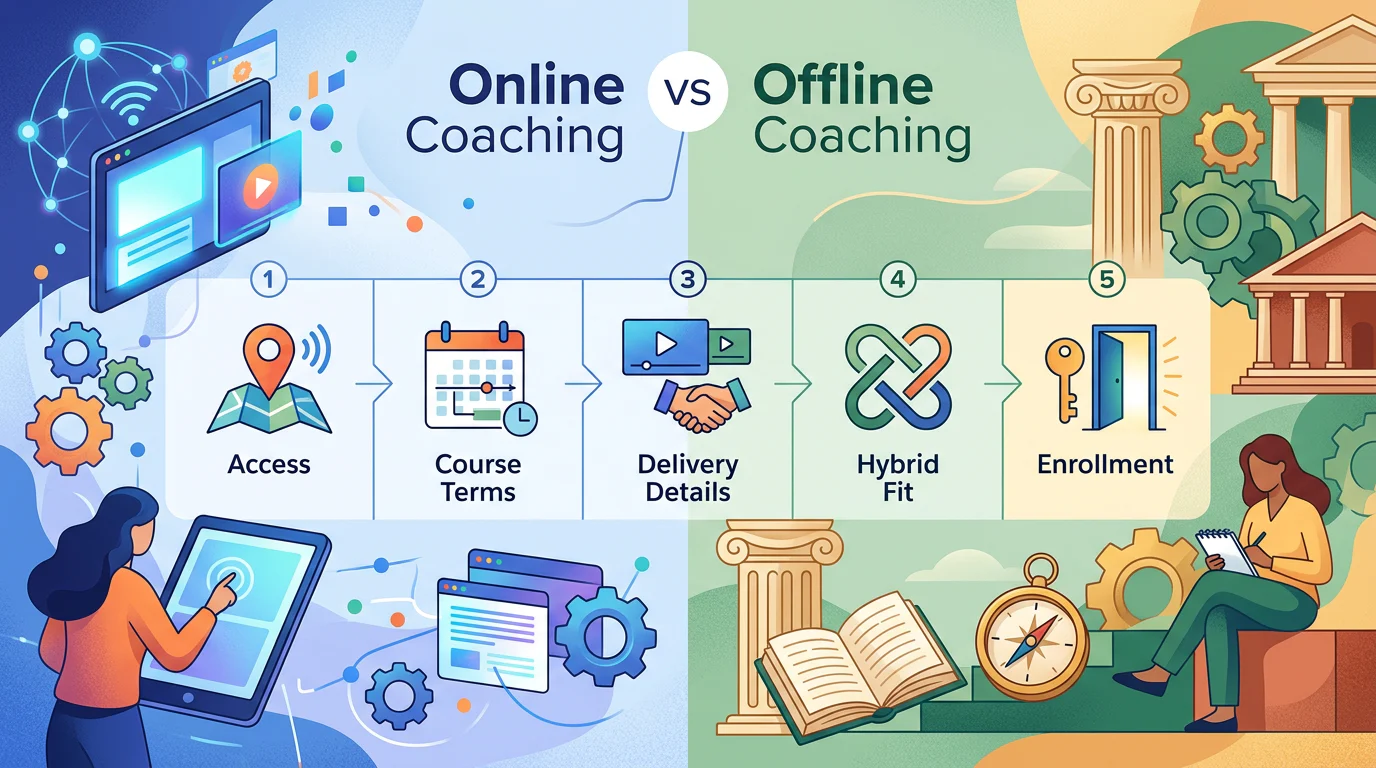
We recommend treating a coaching decision as an operational check, not a response to a headline. Start with the learner’s exam goal and school schedule, then test whether the provider can explain exactly how its online and local-centre components work together.
Check the Learning System
A practical shortlist should answer three questions clearly:
- Timetable continuity: Can the student follow the same planned sequence when attending remotely?
- Assessment access: Are mock tests, feedback and performance review available in both modes?
- Support response: Is there a defined route for academic doubts, attendance changes and parent communication?
Use our online coaching directory to compare virtual options. Where regular local attendance and face-to-face support are essential, ask each provider how its on-site sessions connect with the rest of the batch.
Check the Written Terms
Ask for a current fee schedule, refund policy, batch calendar and centre details in writing. We would also ask whether recordings are included, whether test dates can change, and what happens if a student is temporarily unable to attend. Clear answers are more valuable than broad claims about flexibility.
Check Academic Fit
The best format depends on the student. Some learners need a local routine and regular in-person doubt sessions. Others need a lighter classroom commitment because their school workload is already high. The useful question is not whether hybrid is universally better, but whether this hybrid design supports this learner’s preparation.
What to Watch Before the New Term
The UAE Ministry of Education lists 31 August 2026 as the start date for the 2026-27 academic year for public schools and private schools following the Ministry curriculum in its school calendar. Before that point, we would watch for confirmed batch openings, published faculty schedules, official education-authority updates and written contingency plans.
Students can build an exam plan that accounts for school deadlines, mocks and revision time. The strongest choice will be the one that remains usable when life becomes less predictable, not simply the one with the biggest claimed reach.
Find the Right Coaching Format with Onlinecoaching4u
At Onlinecoaching4u, we think families should be able to compare a coaching format without guessing how it will cope when routines change. We help you frame the questions that matter: whether the batch timetable works with school, how tests and doubt support continue remotely, what a local centre actually provides, and what the written fee and refund terms say. Start by shortlisting programmes that match your exam route and your preferred level of in-person support. Then use our directories and preparation content to compare delivery models on evidence, not urgency. Explore Online Coaching 4u.
FAQs on India-UAE Hybrid Coaching
What Is India-UAE Hybrid Coaching?
It combines scheduled in-person classes with planned online learning. A credible programme preserves teaching sequence, tests, materials and doubt support when students shift between modes.
What Should Parents Ask Before Enrolling?
Request a written timetable, centre location, faculty plan, test calendar, recording access, doubt support, fee schedule and refund terms. These details show whether flexibility works.
Are UAE Classes Back on Campus?
Schools resumed on-site learning in April 2026, while authorised distance options remained for learners unable to attend. Check current instructions with the relevant local authority.